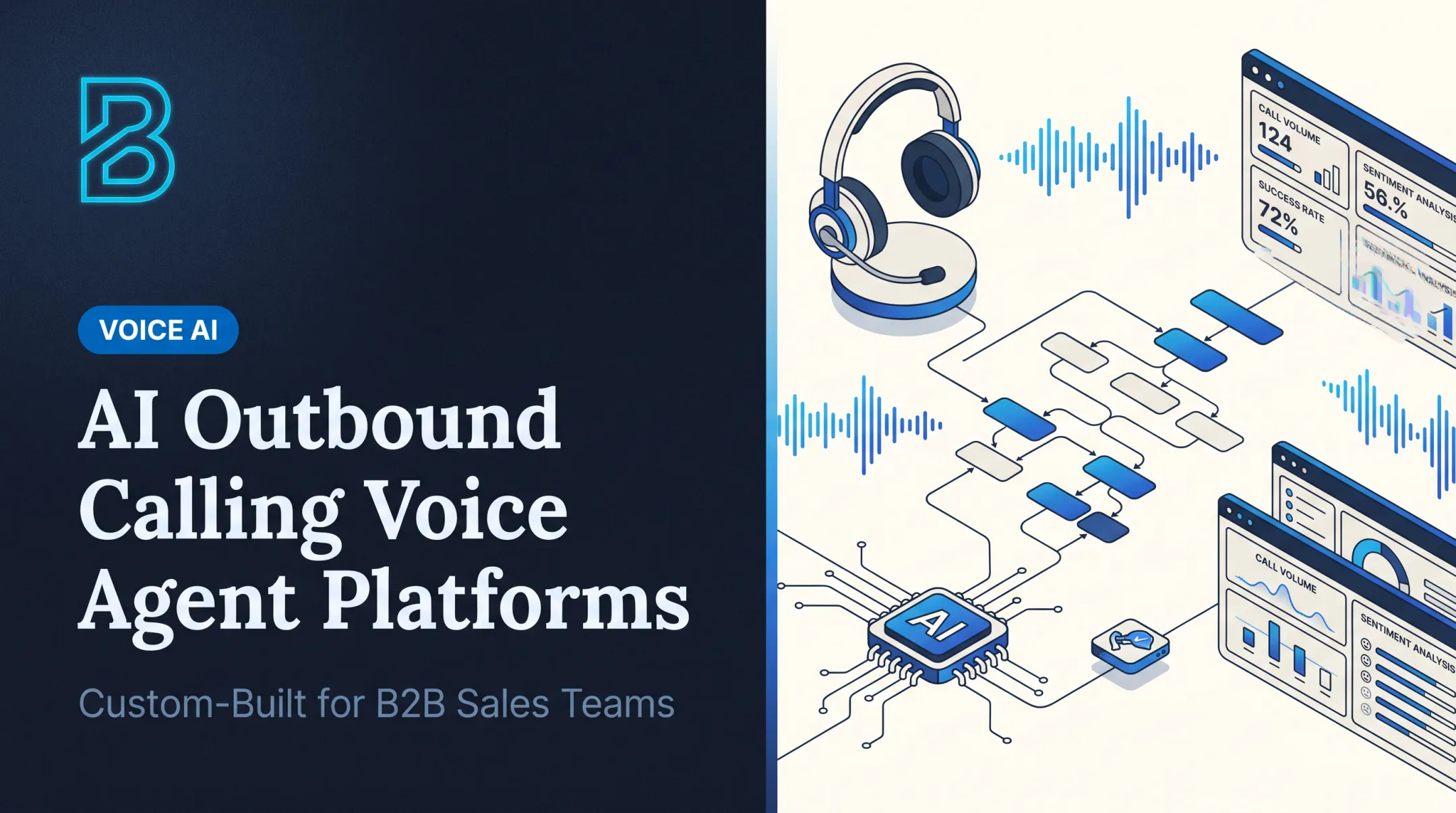

An automated phone system can solve this, but modern solutions go far beyond a simple "press one for sales" menu. Depending on the system, it can route calls intelligently, answer routine questions, book appointments directly into your calendar, update customer records in your CRM, and escalate complex issues to the right person, with the necessary context.
Choosing the right one isn't about finding the longest feature list. It's about matching the technology to your business needs, whether that's boosting your human team's productivity, providing fully automated 24/7 coverage, or building a custom voice workflow that runs on your specific business rules.
Key Takeaways
- Automated phone systems range from traditional auto attendants and cloud-based platforms (UCaaS) to virtual receptionists and conversational AI voice agents.
- Compare systems on their ability to recover missed calls, routing quality, software integrations, and total cost, not just the feature count.
- AI voice agents excel at handling repetitive inbound or outbound conversations, while UCaaS platforms are often better when employees still handle most calls.
- A custom engineering partner is ideal when the system must connect deeply with your CRM, calendar, or other essential business software.
- Always verify current pricing, usage limits, data handling policies, and legal requirements before selecting a provider.
Overview of Automated Phone Systems in the US Small-Business Market
An automated phone system manages your business phone calls without a person handling every interaction. These systems vary widely in complexity and capability. For US small businesses, they are a practical tool for operational efficiency.
Here are the main categories you'll encounter:
- Auto Attendant / IVR: Routes callers with keypad menus ("press 1 for hours, press 2 for support"). IVR also accepts spoken commands for simple tasks and routing.
- Cloud VoIP / UCaaS: Internet calling (VoIP), often bundled with video, messaging, and SMS on one cloud platform (UCaaS). Most include auto attendant features.
- Virtual Receptionist: Can mean a basic auto attendant, or an AI system that greets callers and routes them from spoken needs instead of a fixed menu.
- Conversational AI Phone System: An AI voice agent holds a natural conversation, answers questions, books appointments, and completes tasks without a fixed menu.
For example, dental practice My Smile Miami uses a bilingual voice agent built by Benian Technologies that booked 93 patients in its first month (measured) and has answered 1,600+ after-hours calls (measured).
These systems handle after-hours lead capture, appointment scheduling, and customer service triage. They also cut repetitive work for your team. The key difference is whether a system assists your staff (like UCaaS platforms) or conducts conversations autonomously (like a true AI voice agent). A cheap virtual number won't solve your missed booking problem, but the right automated system can.

Automated Phone Systems for Small Business
We evaluated the following systems based on their ability to reliably answer and route calls, the quality of their automation, integration capabilities, ease of use, human escalation options, and overall value for small-business budgets.
Disclaimer: Product capabilities, pricing, and compliance claims change. Always check the official provider websites for the most current information before making a decision.
Benian Technologies
Benian is an AI engineering company that builds custom Voice AI agents for established US businesses. Founder-led and implementation-focused, it serves teams that need more than a standard phone menu.
They build a voice agent that connects directly to your existing tools, such as your CRM, calendar, or dispatch software, and operates on your business rules. Beyond basic routing, the agent can check connected calendars, book appointments, update customer records, and hand off uncertain requests to a named person by email or Slack, with context.
Their work with Hall's Heating & Air is one example: a voice agent that books HVAC jobs and handles 200+ calls a month at its current pace (measured), with 80% of AI-handled calls arriving after hours (measured). The system runs in your own accounts, and you hold every login and key.
| Category | Details |
|---|---|
| Best-Fit Business | Established businesses needing a voice workflow connected to existing CRM, calendars, or operating software. |
| Implementation Model | Custom build; scope, timing and cost agreed before anything is built. |
| Integration Approach | Direct API connections to customer-owned tools (e.g., Google Calendar, HubSpot, Salesforce). |
| Ownership / Data Model | Built in the client's own accounts; the client holds every login and key. |
| Pricing Model | Custom proposal, no public price. Telephony and AI usage bill the client directly, with no markup. |
Retell AI
Retell AI is a developer-oriented platform for building and deploying conversational AI voice agents. It's designed for teams with the technical capability to configure their own call flows using a drag-and-drop canvas.
This platform is a strong choice for businesses that want a high degree of control over their AI agent's behavior and have the resources to manage it. Retell AI supports both inbound and outbound calling, lead qualification, and appointment booking. It offers native integrations with platforms like HubSpot and Google Workspace. The trade-off for this flexibility is the technical effort required to build, test, and maintain the call flows in a production environment.
| Category | Details |
|---|---|
| Voice Agent Capabilities | Inbound/outbound calling, lead qualification, appointment booking, call transfer. |
| Integration Requirements | Connects via native integrations (e.g., HubSpot) and APIs; requires a SIP trunk for telephony. |
| Pricing Structure | Pay-as-you-go, starting from $0.07–$0.31 per minute. |
| Setup Complexity | Moderate to high; designed for developers or technical teams. |
| Human Handoff | Supports cold, warm, and agentic warm transfers to a human agent. |
| Compliance | States HIPAA and GDPR compliance and SOC 2 certification (requires a signed BAA). |
Dialpad
Dialpad is a comprehensive cloud communications platform (UCaaS) that bundles calling, messaging, and video meetings into one environment. It's enhanced with AI features like real-time call transcription and post-call summaries.
Dialpad is an excellent fit for small businesses where employees still answer the majority of calls but could benefit from AI assistance. The platform's auto-attendant can handle basic call routing, and its AI can transcribe conversations to reduce manual note-taking. For more advanced automation, Dialpad offers separate AI Receptionist and AI Agent products that can handle conversations and book appointments, but these are priced separately from the core UCaaS plans.
| Category | Details |
|---|---|
| Core Pricing (Annual) | Standard: $15/user/month; Pro: $25/user/month. |
| User/Seat Model | Per-user, per-month subscription. |
| Auto-Attendant/IVR | Included; supports custom menus and skill-based routing. |
| AI Features | AI-powered transcription included. AI Agents are a separate product with conversation-based pricing (quoted by Dialpad). |
| Integrations | Google Workspace/Microsoft 365 (Standard); CRM integrations like Salesforce and HubSpot (Pro). |
| Remote Work | Full-featured mobile and desktop apps for iOS, Android, PC, and Mac. |

RingCentral
RingCentral is one of the most established and feature-rich UCaaS providers on the market. It offers a broad suite of communication tools, including voice, video, messaging, and integrations, with a potential pathway to expand into a full contact center solution.
For some small businesses, this breadth is a major advantage, providing a single vendor for all communication needs. For others, it can introduce unnecessary complexity and cost. RingCentral's core plans include a multi-level auto attendant and AI-powered IVR for intelligent routing. Like Dialpad, it offers a more advanced AI Receptionist as a standalone product or add-on, which can answer calls, book appointments, and update CRMs.
| Category | Details |
|---|---|
| Core Pricing (Annual) | Core: $20/user/month; Advanced: $25/user/month. |
| Auto-Attendant/IVR | Multi-level auto attendant and AI IVR included in RingEX plans. |
| AI Receptionist | Available as an add-on (from $39/month, including 100 minutes) or standalone (from $49/month). |
| Integrations | Extensive library of 330+ integrations, including major CRMs. |
| Administration | Requires an administrator to configure call handling and routing rules. |
| Add-on Costs | Be aware of potential costs for extra minutes, specific integrations, or advanced features. |
Nextiva
Nextiva is another leading unified communications platform that combines business calling with messaging, analytics, and collaboration tools. It positions itself as a solution for managing the entire customer experience from a single dashboard.
This platform is a strong contender for businesses that want a predictable, all-in-one system with straightforward administration. Nextiva's plans include an auto attendant for menu-based call routing. It also offers an AI Receptionist add-on (XBert AI) for conversational call handling, priced separately from the core plans. The choice between Nextiva and a more specialized AI provider depends on whether you prioritize a unified platform or need a deeply integrated, task-oriented voice agent.
| Category | Details |
|---|---|
| Core Pricing (Annual) | Core: $15/user/month; Engage: $25/user/month. |
| Phone System Features | Auto attendant, call-flow builder, time-based routing. |
| AI Answering | XBert AI Receptionist is available as an add-on, priced separately. |
| Integrations | Supports Salesforce, HubSpot, Zendesk, Microsoft Teams, and others. |
| Contract Requirements | Annual billing offers the lowest price; verify contract terms. |
| Scalability | The platform is designed to scale with business growth. |
How We Chose These Automated Phone Systems
Our evaluation process started with the real-world problems small businesses face, not with a checklist of features.
Automation Depth and Workflow Execution
We looked at what each system can actually do. Does it just forward calls based on a menu, or can it complete a task?
True workflow execution is a chain of actions. When a customer calls to rebook, the system should do more than take a message. It checks your Google Calendar for availability, moves the appointment, updates the HubSpot CRM record, and sends a confirmation text, all without human input.

We prioritized systems that could show this level of integration.
Caller Experience and Failure Handling
A frustrating phone system is worse than no system at all. We assessed the caller's journey, looking for:
- Plain language: Does the system understand natural speech, or does it force rigid commands?
- Robustness: How does it handle accents, background noise, or interruptions?
- Easy escalation: Can a stuck caller reach a human quickly? Benian's voice agent for Discovery Dental made 320 warm transfers with a summary in its first five months (measured).
- Safe failure: What happens when a request is unsupported? The system should have a configured fallback, like sending the details to a specific team member, not just dropping the call.
Total Cost of Ownership (TCO)
The advertised price is rarely the final price. We looked beyond the per-user or per-minute rate to calculate the TCO, which includes:
- Monthly seat or subscription fees.
- Per-minute or per-conversation AI usage costs.
- Charges for phone numbers and telephony.
- Fees for essential integrations.
- One-time setup or implementation costs.
- Potential overage charges.
For example, a UCaaS plan might seem cheap at $20/user, but if you need a true AI receptionist, that could be an extra $39/month or more plus overages. A custom build may have a higher upfront cost, but outside tools bill you directly in your own accounts, with no markup.
US Compliance and Data Handling
Handling calls and customer data carries legal responsibilities. We verified that providers address key US compliance areas:
- Outbound Calling: The FCC confirms that TCPA restrictions on prerecorded voices now explicitly include AI-generated voices, requiring express consent for automated outreach.
- Call Recording: Federal law requires one-party consent, but many states (like California, Florida, and Illinois) require all-party consent. Your system must support proper disclosures.
- HIPAA: If you handle PHI, the provider must sign a BAA and support HIPAA-compliant configurations, per HHS cloud guidance.
Conclusion
The "best" automated phone system is the one that solves your specific call problem, not the one with the most recognizable brand or the longest feature list.
If your team just needs better tools to manage calls they already answer, a UCaaS platform like Dialpad or RingCentral is a solid starting point. If you need a unique conversational workflow and have the technical team to manage it, a platform like Retell AI gives you more flexibility.
Before you commit, test each potential solution against real-world scenarios:
- A new lead calling in
- A last-minute appointment change
- An urgent after-hours request
- A confused caller who needs a person
Measure what matters: fewer missed calls, more completed tasks, successful human transfers, and positive customer feedback.
If your business needs a voice workflow deeply connected to your tools and operating rules, a custom engineering partner may be the right path. Benian builds these systems around your operational challenges, in your own accounts, with handoff to a named person when the agent should not decide alone.
To size the problem first, try the free Missed-Call Calculator. If you're ready to discuss your process and integration needs, book a 30-minute call.
Frequently Asked Questions
How much does an automated phone system cost?
Costs vary by type. UCaaS platforms like Dialpad or RingCentral often charge $15–$35 per user per month. Usage-based AI agents are priced per minute (for example, $0.07–$0.31 on Retell) or per conversation. Custom-built systems are priced by proposal, with ongoing telephony and AI usage billed separately.
How much does an AI phone answering system cost?
Flat-rate AI receptionist add-ons, like RingCentral's, can start around $39-$49 per month with a set number of minutes. Usage-based voice agents have variable costs depending on call volume and conversation length. A custom system from a partner like Benian is priced by custom proposal, with scope, timing and cost agreed before the build.
Is there a way to automatically answer phone calls?
Yes. Auto attendants route calls via menus. Virtual receptionists and AI voice agents can understand spoken requests to answer questions, book appointments, and complete tasks. The best choice depends on how much intelligence and autonomy you need.
What is an automated phone system?
It's a broad term for technology that manages phone calls. That ranges from simple automated greetings and menu routing (IVR) to cloud phone platforms (UCaaS) and conversational AI agents that handle full conversations and tasks.
What is the best automated phone answering system for small businesses?
There is no single best system. UCaaS platforms suit teams that need stronger call management. Dedicated AI voice agents are better for automating booking, qualification, and similar repetitive tasks. Choose based on call volume, complexity, and integration needs.
Is IVR the same as auto attendant?
The terms are often used interchangeably, but they aren't identical. An auto attendant primarily routes callers through keypad menus. An IVR system can be more advanced, supporting spoken input, looking up data from other systems, and enabling multi-step self-service workflows.