
AI cold calling agents promise to close that gap: systems that dial, converse, qualify, and log a call without a human on the line for every attempt. But that raises an obvious question: can software actually run a sales conversation, or does it just play back a script?
This guide covers how AI cold calling agents work, where they fit and where they don't, what a real implementation requires, and the US compliance rules that govern any outbound calling program. The goal isn't automation for its own sake. It's giving sales teams more structured first-touch coverage while keeping judgment, negotiation, and relationship-building with people.
Key Takeaways
- AI cold calling agents place live calls, qualify prospects, and book next steps; they don't just play a recording.
- They differ from AI-assisted dialers, call simulators, and robocall systems, none of which hold a genuine two-way conversation.
- The strongest programs pair automation for routine work with human escalation for objections and high-value deals.
- Clean CRM data, tested workflows, and clear opt-out handling determine whether a deployment actually works.
- US compliance depends on consent, call technology, and state law, so verify current rules before launch, not after.
What Is an AI Cold Calling Agent and How Does It Work?
An AI cold calling agent is a voice system built to hold a live, two-way conversation on an outbound call, not to play a fixed recording. It listens to what the prospect says and decides how to respond within a defined workflow. The call continues until it reaches a natural stopping point: a booked meeting, a qualified disposition, a transfer, or a polite close.
That distinction matters because "AI for cold calling" gets used loosely to describe four very different tools:
- Autonomous cold calling agents hold the actual conversation with the prospect, in real time.
- AI-assisted tools generate scripts, score leads, transcribe calls, or coach a human rep who's still doing the talking.
- Call simulators are used for internal training and objection-handling practice, never dialing real prospects.
- Autodialers and robocall systems automate dialing or playback without genuine conversational reasoning.
Only the first category is a true AI cold calling agent. The rest support the process without replacing the conversation.
How the technology works
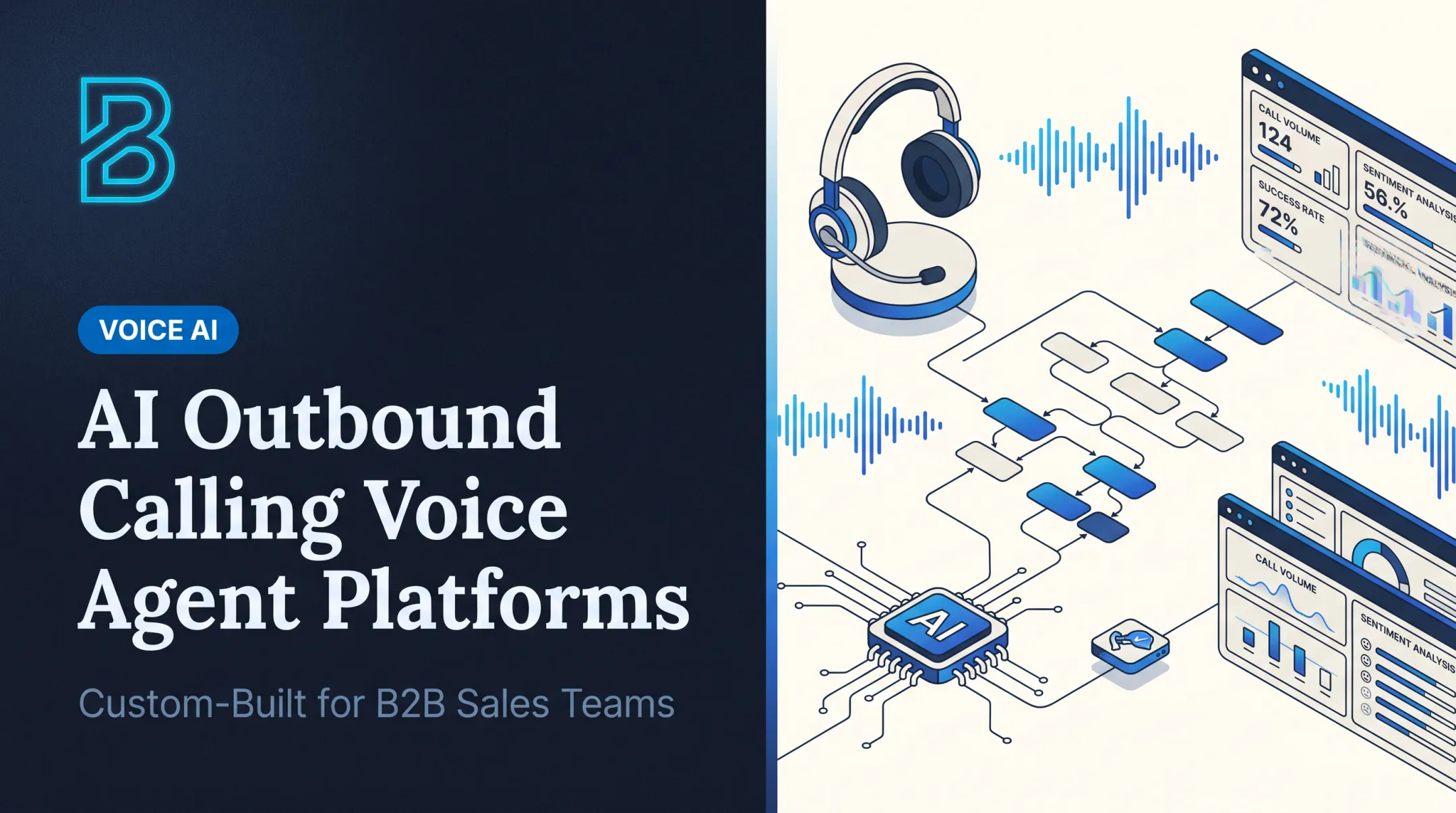
These systems combine four components in a streaming pipeline:
- Speech recognition to hear the prospect
- A language model that interprets what was said and picks the next move from an approved playbook
- Text-to-speech to generate the reply
- Integrations that read from and write to the CRM, calendar, and phone system
A 2025 academic study on telesales voice agents found this architecture performs nearly as well as human reps on routine segments of a call, like confirming details or asking qualifying questions, but is noticeably weaker on persuasion and complex objection handling. That's a useful signal: automate the structured parts of a call, not the whole sales conversation.
A basic B2B call flow
A typical structured call runs something like this:
- Confirm the prospect is the right contact for the topic at hand.
- Introduce the business and the reason for the call in a sentence or two.
- Ask two or three qualifying questions tied to the offer.
- Offer a relevant next step, such as a demo, a meeting, or a resource.
- Transfer to a human or schedule the meeting directly in the calendar.

The agent can personalize using approved context, such as industry, role, prior interactions, or a documented account brief. What it should never do is guess at facts or invent claims about pricing or capability. That's the line between a useful assistant and a liability.
Why Sales Teams Use AI Cold Calling Agents
Sales teams adopt AI cold calling agents to extend structured outbound coverage, not to replace the judgment a closer brings to a deal. Coverage is the point: agents absorb the volume of initial dials that would otherwise eat a rep's day.
Where agents add the most value
- Repetitive outreach: initial contact attempts, basic qualification, reminders, and routine follow-up.
- Consistency: the same approved messaging and escalation rules on every call, with no drift between reps.
- Extended coverage: outreach outside a standard 9-to-5 schedule, where lawful and operationally sound.
- Cleaner administration: notes, dispositions, and next steps logged directly into connected systems instead of typed up after the fact.
- Sharper sales intelligence: patterns in objections and where prospects disengage, surfaced across hundreds of calls instead of a handful.
One documented example: as part of a Claude enablement and Voice AI engagement, Benian Technologies built an outbound voice agent for E-Ihracat Turkiye, an e-commerce education business in Türkiye.
In its first week live, the agent booked 15 meetings, and four of those meetings closed for roughly $8,000 in sales (client-reported). The full engagement is described in the E-Ihracat Turkiye case study.
Where humans still win
Agents handle structure well. They handle nuance poorly. Discovery calls, negotiation, strategic-account relationship work, and sensitive decisions still belong with a person. Blind-testing data has found voice agents competitive on routine segments but weaker on persuasion.
Good fits:
- Lead qualification and appointment setting
- Reactivating dormant-but-permissible contacts
- Confirmation workflows
- Routing interest to the right salesperson
Poor fits:
- Complex consultative selling
- Emotionally sensitive conversations
- High-stakes regulated decisions
- Poorly documented offers
- Campaigns where consent or data provenance is unclear
How to Implement and Evaluate an AI Cold Calling Agent
Don't try to automate the whole sales process on day one. Start with one narrow, measurable workflow:
- A specific audience
- A single call objective
- A short list of qualifying questions
- Clear handoff criteria
- Topics the agent should never touch
Audit before you build
Before deployment, confirm three things:
- Data quality: lead records, phone numbers, contact permissions, and segmentation are accurate and current. Merge duplicate contacts and flag dead numbers first.
- System map: document exactly which CRM, calendar, telephony, and reporting tools the agent needs to read from and write to.
- Approved content: pricing boundaries, FAQs, objection responses, brand voice, and the specific claims the agent is allowed to make.
Build in escalation from the start
Every agent needs clear triggers for handing a call to a person: uncertainty, requests outside the knowledge base, urgent issues, an explicit request for a human, or anything sensitive.
Escalation flows built by Benian are designed to route these calls to a named team member by email or Slack with enough context to pick up the thread without asking the prospect to repeat themselves.
Test before you launch
Run internal calls first. Push the agent with realistic objections, interruptions, silence, voicemail, wrong numbers, opt-out requests, and failed integrations. If it can't handle those cleanly on a test line, it isn't ready for a prospect's line.
Measure what matters
Track the metrics that reflect real pipeline movement:
- Connection rate and conversation completion
- Qualified opportunities
- Booked meetings and show rate
- Opt-out rate, transfer rate, and error rate
Define each metric before launch and compare against your existing process. Don't lean on someone else's benchmark for your list and your market.
Build versus buy
A standard platform works when the workflow is common and speed matters more than customization. A custom build makes more sense when the business has distinctive processes, several connected systems, or a need to own the system outright.
Either way, confirm the provider leaves you with usable documentation, credentials you control, and access to your own data, not a black box you're renting.

Benian agrees the scope, timing, and cost of a calling-agent build before anything is built, and builds the system in the client's own CRM and phone accounts, with the client holding every login. One example is Deep Sea Media, a paid media agency in Canada, whose CRM was connected to an automated calling agent; the build is written up in Deep Sea Media's CRM calling agent.
US Compliance, Privacy, and Risk Controls
AI cold calling isn't automatically legal or illegal. Whether a specific campaign is permitted depends on the call's purpose, who's being called, consent status, the technology used, and which federal and state rules apply.
What to verify before you dial
- AI voice is not a workaround. The FCC confirmed in February 2024 that an artificial or prerecorded voice under the TCPA includes AI-generated voices that sound human. A natural-sounding agent gets no special exemption.
- Consent and opt-out rules apply. Telemarketing robocalls to consumers generally require prior express written consent, and every call needs a working opt-out mechanism.
- Revocation has a clock. Consent can be revoked through any reasonable method, and callers must honor a revocation request within 10 business days.
- Both DNC lists apply. Scrub against the National Do Not Call Registry at least every 31 days, and separately honor company-specific opt-outs.
- State rules add another layer. Some states require all-party consent to record a call; others allow one-party consent. Calling-hour and caller-ID requirements also vary by state.
Don't treat B2B as a blanket exemption
Most business-to-business calls are exempt from the FTC's Telemarketing Sales Rule, but that exemption is narrower than it sounds. It doesn't extend to every FCC rule, state law, or recording requirement.
Treating "we only call businesses" as a compliance strategy is one of the fastest ways to end up in a dispute.

Build these controls into the operating model:
- Maintain and honor suppression and opt-out lists promptly.
- Identify the business accurately and transmit compliant caller ID.
- Disclose AI use where required or where it builds trust.
- Document consent and data sources for every list you call.
- Set retention limits for recordings, transcripts, and call metadata.
- Restrict calling windows to what's locally permitted.
None of this replaces legal review. Get a documented review from qualified US counsel for the specific campaign and states involved before scaling past a pilot.
Conclusion: Use AI Cold Calling to Extend Sales Capacity, Not Remove Sales Judgment
The best AI cold calling programs don't replace a sales team. They extend it.
Automation takes the repeatable first-touch work off a rep's plate: the initial dial, the qualifying questions, the calendar booking, the CRM note. Judgment on the harder calls stays with people who can read a room the software can't.
If you're evaluating this for your own pipeline, start small:
- Pick one workflow, not the whole funnel.
- Define the business outcome you're trying to move: meetings booked, response time, or hours saved.
- Audit your data and compliance requirements before writing a single line of script.
- Test the conversation on an internal line first.
- Compare results against your current process, not a vendor's benchmark.
Businesses that need a connected, customer-owned Voice AI agent can work with Benian. Builds connect to your CRM, calendar, and escalation rules in your own accounts rather than a rented platform, and each scoped implementation targets a measurable revenue, cost, or time outcome. To talk through your outbound workflow, book a 30-minute call.
Frequently Asked Questions
Does cold calling still work in 2026?
It can still contribute to a pipeline when targeting, timing, and follow-up are strong. HubSpot's 2025 cold calling report found that 38% of respondents who cold call regularly (but not daily) viewed setting a meeting or demo as the most positive outcome of a call, rising to 43% among those who cold call daily.
Can AI agents cold call and handle sales or telemarketing calls?
Yes, for structured tasks: introductions, qualification, FAQs, scheduling, and routing to the right person. Complex selling and sensitive conversations still perform better with a human on the line.
Are companies using AI for sales calls?
Broadly, yes. Many sales teams have adopted AI somewhere in their prospecting workflow. Autonomous voice agents specifically remain a newer, less-measured category compared to AI-assisted tools like scoring and transcription.
Is it legal to use AI for cold calling?
Legality depends on consent, the calling technology used, disclosures, opt-outs, recording rules, and jurisdiction. Review current FCC and FTC guidance and applicable state law with qualified legal counsel before launching a campaign.
Is B2B cold calling illegal?
No, but B2B status doesn't automatically clear every rule. Businesses still need to review applicable telemarketing, caller-ID, opt-out, and state-specific requirements before calling business contacts.
What is the 80/20 rule in cold calling?
It's a prioritization heuristic suggesting a small share of prospects, reps, or activities often drive a disproportionate share of results. Treat it as a lens for testing your own data, not a guaranteed ratio.