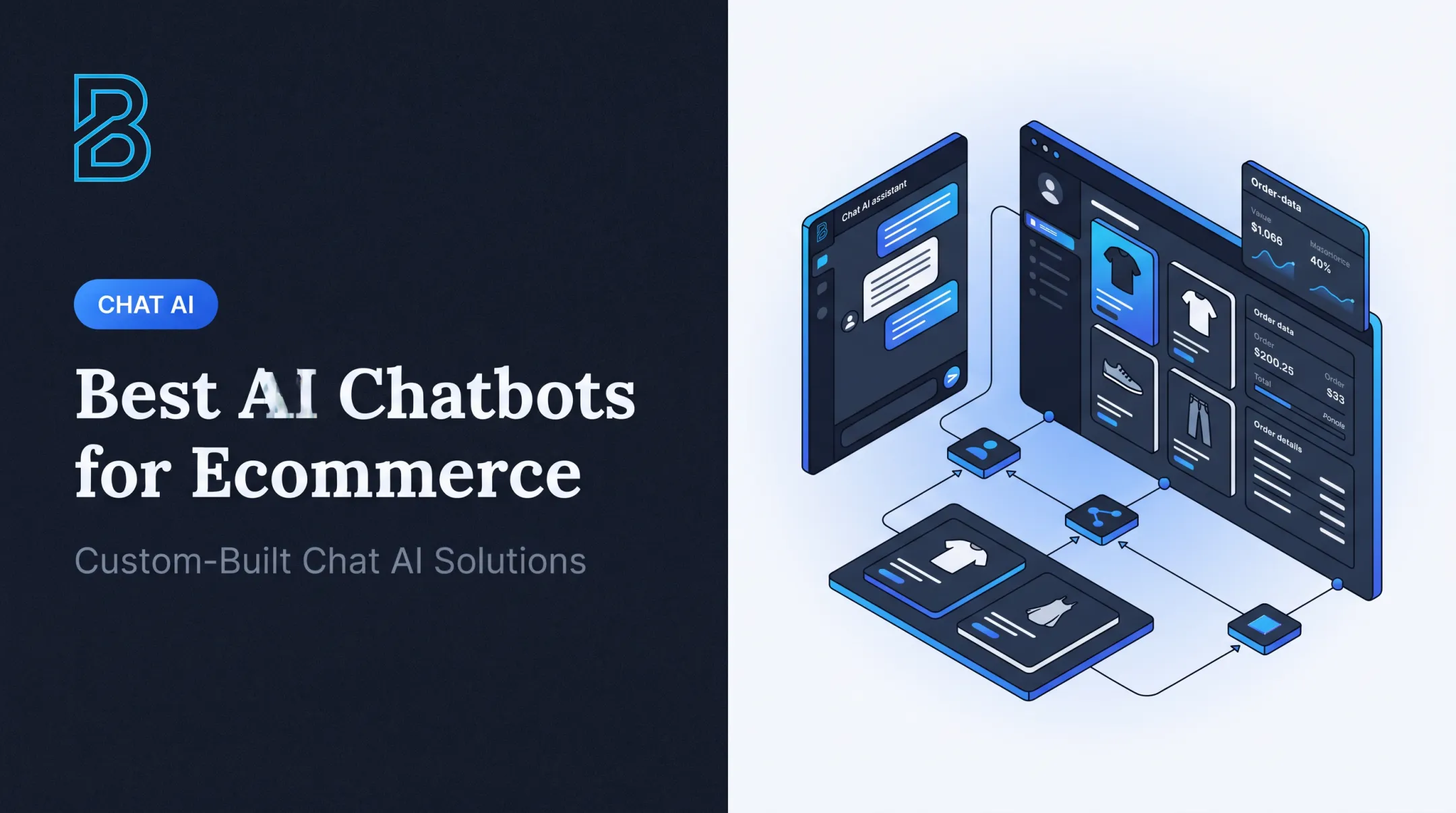

That era is ending. In 2026, AI agents interpret context, pull real order data, take permitted actions, and know when to hand a case to a person. The shift isn't cosmetic. It changes what "customer support software" or "marketing tool" actually does inside a business.
There's no single best agent, though. The right choice depends on the problem you're solving: customer support, merchandising, marketing, inventory, or full shopping assistance. This guide compares five leading options for US ecommerce businesses in 2026, evaluated on integration depth, execution capability, governance, scalability, and measurable business impact.
Key Takeaways
- Ecommerce AI agents pursue a goal, act on connected business data within permissions, and escalate uncertain cases to humans.
- The strongest platforms reliably complete specific workflows inside clear permissions, not maximum autonomy.
- Intercom Fin, Gorgias, Ada, Shopify's native tools, and Klaviyo AI each solve different problems; none is a universal winner.
- Verify current pricing, integrations, and data-handling policies before committing. 2026 feature sets shift fast.
Overview of AI Agents in the Ecommerce Market
Not every "AI-powered" tool works the same way. Here's the distinction that matters:
- Rules-based chatbot: follows a scripted decision tree; only answers questions its author anticipated.
- AI assistant: observes and advises, but a person still acts on the recommendation.
- AI agent: reads context, calls tools, updates records, and adapts to situations it wasn't explicitly trained for.
- Agentic commerce: purchases initiated, influenced, or completed by an AI agent rather than a human clicking through checkout.
Gartner's control model ranges from "observe and advise" to "act with approval" to "act autonomously." Most production ecommerce systems today sit in the middle two categories, not full autonomy.
Where the value actually shows up
Documented workflows where agents create measurable value include:
- Order-status and returns support
- Product discovery and catalog Q&A
- Marketing personalization and cart-recovery flows
- Merchandising content generation
- Store administration and reporting tasks
Adoption is accelerating faster than most teams expect. In an August 2025 press release, Gartner predicted that up to 40% of enterprise applications will include integrated task-specific agents by 2026, up from less than 5% in 2025. Bain goes further for retail specifically, forecasting that AI agents could be responsible for 15% to 25% of US ecommerce sales by 2030.

That trajectory raises the stakes on data quality. An agent is only as good as the order records, product feeds, and policy documents it reads from. Messy catalog data or an outdated returns policy no longer yields a weak reply; it triggers the wrong action. The same feed quality also shapes how AI search surfaces your products, as covered in this piece on Google AI Mode and product feeds.
AI Agents for Ecommerce in 2026
This ranking includes platforms with meaningful ecommerce applications, documented agent capabilities, current integrations, and credible customer evidence. Each one fits a different operating model. Read for fit, not for a universal winner.
Intercom Fin
Fin is built for teams that have outgrown FAQ bots. It draws on help-center content, internal documents, and customer data to answer questions with real context rather than generic scripts.
Where Fin earns its keep:
- Order questions, returns, refunds, exchanges, and subscription changes on Shopify stores
- Multilingual support across more than 45 languages
- Configurable human handoff, including automatic escalation for sensitive content
- Draft-then-approve "procedures" that call Shopify APIs directly for post-purchase tasks
That last point matters. Some Fin actions are live and autonomous; others are drafted and require review before they execute. Confirm which mode applies to your workflow before rollout.
Pricing, per Intercom's pricing page, starts at $29 per seat/month billed annually (Essential), scaling to $85 (Advanced) and $132 (Expert), with Fin billed separately at $0.99 per outcome. Intercom reports that Fin averages a 76% resolution rate across more than 12,000 customers (a vendor figure across all industries, not an ecommerce-specific or independent benchmark).
The catch: Fin's ecommerce integration documentation centers on Shopify. If your stack runs elsewhere, expect more custom integration work.
Gorgias
Gorgias is the natural pick for Shopify-native and direct-to-consumer brands that want a helpdesk, not just a bot bolted onto one.
Its AI Agent handles email, chat, SMS, and social channels including Instagram DMs and WhatsApp. It reads order data from Shopify, BigCommerce, Magento, or WooCommerce, and can execute configured actions like:
- Canceling orders
- Processing returns
- Updating shipping addresses
Handoff triggers on low confidence, sensitive topics, or customer frustration. This is bounded automation, not unrestricted autonomy. Gorgias documentation is explicit that the AI Agent is not a macro system, though it still relies on "skills" that encode specific intents and instructions.
Pricing combines a monthly helpdesk plan with per-resolution AI charges. According to Gorgias' pricing page, plans start at $10/month (Starter, 50 tickets), and each AI Agent resolution costs $0.90 on annual billing or $1.00 on monthly billing.
Its built-in Revenue Statistics feature is genuinely useful: it tracks money generated through the support journey, not just tickets closed.
Ada
Ada is aimed at larger, more globally distributed support teams that need structured governance over raw autonomy.
Ada's "Playbooks" encode multistep standard operating procedures: authenticate a user, check an account, execute a workflow, update the system of record, then confirm the outcome. Its Performance Center supports simulation testing before anything reaches production, and its intent taxonomy organizes requests into topics and sub-intents for cleaner analytics.

What sets Ada apart on paper:
- SOC 2 Type II, HIPAA, GDPR, and PCI DSS documentation
- Independent penetration testing
- A vendor-reported 84% automated resolution rate, with AI agents offered across voice, messaging, and email
There's no public pricing page. Ada routes prospects through a demo request based on expected annual contact volume, which signals enterprise-first positioning.
Reality check: the documentation covers customer-service operations well but says nothing about native merchandising or inventory workflows. For a small store handling a few hundred tickets a month, Ada is likely overbuilt.
Shopify Sidekick and Shopify's Native AI Tools
Shopify doesn't ship one universal agent; it ships an ecosystem. Treat it that way.
Sidekick is the operational assistant: it analyzes store data, manages orders, edits products, creates natural-language customer segments, and works with third-party apps. Every staff member can access it, subject to admin permissions.
Shopify Magic is the content layer: product descriptions, email subject lines, blog drafts, and suggested replies inside Shopify Inbox.
Both come with real boundaries. Sidekick cannot talk to customers directly, cannot access another merchant's data, and never changes a shop without presenting options for approval first. That last constraint is intentional: it keeps a human in the loop for every meaningful change.
Best fit: Merchants who want the lowest-friction starting point already embedded in their existing subscription. Limitation: Sidekick doesn't replace a cross-system agent that needs to talk to your helpdesk, CRM, and marketing platform at once. It stays scoped to the Shopify admin environment.
Klaviyo AI and Ecommerce Marketing Agents
Klaviyo's AI tools solve a different problem entirely: lifecycle marketing, not support tickets.
Klaviyo says it has shipped more than 40 AI capabilities since 2017, including:
- Product recommendations tied to catalog data
- Predicted customer lifetime value
- AI-built flows and segments
- A Marketing Agent that can draft campaigns, flows, and forms in a handful of clicks
Autonomy varies by feature. The Marketing Agent page describes generating and optimizing assets without prompts, while Klaviyo's Campaign Builder documentation is clear that copy, audience selection, and scheduling all require human approval at every step. Don't assume platform-wide autonomy. Check the specific feature.
Pricing starts with a free plan (up to 250 active profiles and 500 emails/month), scaling with profile count and message volume.
The dependency to watch: these agents are only as sharp as your event data and product feed. A messy catalog produces messy recommendations, no matter how good the model is.
How We Chose These AI Agents
This ranking weighted verified business outcomes over feature checklists.
We asked five questions of every platform:
- What's the verified automation rate, not the marketed one?
- How many resolutions actually close the loop without human rework?
- What's the cost per verified resolution, including human review time?
- Does the agent influence revenue or conversion, and can that be attributed?
- How much employee time does it genuinely free up?
Integration depth mattered as much as headline capability. For each platform, we checked whether it could read data, recommend an action, or execute a change. Those are three very different levels of access across order management, CRM, helpdesk, payment systems, and product catalogs.

Governance and safety checks included:
- Confidence thresholds and approval steps before high-risk actions
- Audit logs and rollback options if an agent gets something wrong
- Sandbox testing before production access
This is where a lot of ecommerce teams get burned. A sensible design lets an agent read live order records and handle routine requests inside written policy, while irreversible actions such as refunds wait for a human approval. That single guardrail is designed to prevent the most common failure mode: an agent confidently taking an irreversible action on bad data. Benian Technologies follows this approach in its builds; for VOT Distribution, a multi-brand ecommerce distributor, that work includes two AI storefront assistants in production (measured).
Common mistakes worth avoiding:
- Choosing a tool because it has a "generative AI" label, not because it solves your workflow
- Confusing ticket deflection with actual resolution
- Giving an agent production access before testing it in a sandbox
- Ignoring channel context: a policy that works for email may fail for SMS
- Skipping a baseline metric, so you can't prove ROI later
Conclusion
The best AI agent for ecommerce in 2026 is the one that reliably improves a defined workflow, connects to the systems where decisions actually get made, and keeps a person in the loop when judgment is required.
Start narrow. Pick one measurable use case (order-status support, returns, product discovery, or inventory alerts) and expand only after tracking accuracy, customer experience, operational savings, and escalation volume for a few weeks.
If you're an established US ecommerce business weighing a custom build against an off-the-shelf platform, Benian builds custom AI agents for one defined task, with actions and human approvals agreed before development. Systems connect to the tools you already run, stay in accounts you own, and route uncertain cases to a named person rather than guessing. You can book a 30-minute call to talk through your store's workflow.
The goal is a durable system tied to measurable outcomes, not a demo that looks good and stalls in production.
Frequently Asked Questions
What is an ecommerce agent?
An ecommerce AI agent interprets a goal, uses connected commerce data and tools, and takes authorized actions like processing a return. Unlike a basic chatbot on a scripted tree, it escalates exceptions to a person.
How do I use AI for my ecommerce business?
Start with one high-volume, measurable workflow, such as order-status questions. Connect trustworthy data, set permissions and escalation rules, test in a sandbox, then track a baseline metric before you expand.
Which AI agents are best for ecommerce?
It depends on your workflow and stack. Intercom Fin and Gorgias suit support, Ada suits large teams, Shopify tools suit store ops, and Klaviyo AI suits marketing. Verify 2026 capabilities before choosing.
Does Shopify use AI agents?
Shopify offers native AI tools like Sidekick and Magic, plus support for third-party AI apps. The level of autonomy varies by tool, merchant plan, and permissions, so check current Shopify documentation for specifics.
What are the 7 types of ecommerce?
The commonly cited categories are B2C, B2B, C2C, C2B, B2G, G2B, and G2C, though classification frameworks vary by source. AI-agent requirements differ significantly depending on which transaction type you're automating.